

Happy holidays and welcome to our Q4 2025 newsletter! ⛄ As we welcome the new year, this last quarter has invited reflection not just on what we build, but on how power, responsibility, and agency are distributed across the systems we rely on.
In Q4, our work focused on governance under real-world constraints: digital sovereignty, collective intervention across the AI stack, and the limits of participation at scale. We contributed to strategic policy recommendations in Europe, new frameworks for collective governance in AI, and ethnographic perspectives on organizational intelligence.
Across research, writing, and collaboration, these efforts reinforce our commitment to systems that remain steerable, accountable, and resilient—especially as complexity increases.
In this issue, you’ll find:
- Policy and governance frameworks shaping digital sovereignty and AI futures
- New writing on collective governance, ethnography, and participation
- Conversations bridging academic research and real-world practice
- Community highlights, events, and celebrating BlockScience’s birthday! 🎂
Thank you for being part of this ongoing work and our community 🙏

The Santa Protocol
In a holiday thought experiment, Michael Zargham, BlockScience Founder and Chief Engineer, explores The Santa Protocol, deconstructing the legend of Santa Claus as a complex socio-technical system. He examines institutional design, governance, and the Knowledge Organization Infrastructure (KOI) required to manage a global coordination challenge of mythical proportions. The article offers insights into how we structure shared realities, manage decentralized information, and engineer the protocols that allow large-scale human systems to function reliably. It is a perfect end-of-year reflection on the rigorous, often invisible frameworks that support our world, reminding us that even the most magical outcomes are rooted in sound engineering and thoughtful design.
Rebalancing Europe’s Digital Power
Michael Zargham co-authored a new policy brief with The European Decentralisation Institute, Rebalancing Europe’s Digital Power. The brief argues that digital sovereignty will not come from more rules, but from infrastructure that Europe can actually govern and steer. The report, co-authored by Dr. Christoph Kreiterling, Dr. Wessel Reijers, and Prof. Roman Beck, outlines how decentralisation can close Europe’s “sovereignty gap.” It also proposes four concrete policy priorities to guide European digital infrastructure over the next 36 months.
Collective Governance for AI: Points of Intervention
Research colleagues of the Metagov community have released a new framework identifying practical points of intervention across the AI stack, from model design and data to deployment, policy, and culture. The document reframes AI as a collection of governable systems, emphasizing collective governance, feedback loops, and community accountability, with contributions from researchers and practitioners, including our own Michael Zargham.

Governance Overload: The Silent Killer of Participatory Systems
As decision rights expand, leaders face a new constraint: limited human attention. In Governance Overload: The Silent Killer of Participatory Systems, Nathan Schneider, Ronen Tamari, and Michael Zargham explore attention as a critical bottleneck in digital governance and share practical heuristics for designing participatory systems that remain resilient and responsive.
IWORD 2025: International Workshop on Reimagining Democracy
BlockScience Senior Researcher Eric Alston attended the International Workshop on Reimagining Democracy (IWORD) at Yale University, along with colleagues from Metagov, POPVOX Foundation, Harvard University, MIT Sloan School of Business, Microsoft, OpenAI, Google Deepmind, and others. This was a small, invitation-only gathering focused on how democracy, markets, and technology interact. At BlockScience, we're actively engineering towards a healthier dynamic interplay between democratic institutions, market institutions, and the institutions that infrastructure our society through the provision of information technologies.
8 Critical Insights from My Forthcoming Book on Blockchain Security
How do communities coordinate under persistent digital insecurity? In this blog post, Kelsie Nabben, BlockScience fellow and senior social scientist, distills eight core insights from her forthcoming book, Decentralised Digital Security: Code, Community, Crisis, drawing on ethnographic research into crisis response, legitimacy, and collective security practices.
Building the Loop: The Role of Ethnography in Artificial Organizational Intelligence
Derived from a talk at EPIC 2025, this post by Ellie Rennie, BSci research colleague, explores Artificial Organizational Intelligence (AOI) as an alternative to consumer-facing AI. Drawing on ethnographic practice and technical work on Knowledge Organization Infrastructure (KOI), the piece outlines how organizations can make knowledge legible, governable, and machine-readable without erasing local rules, practices, or boundaries.

KOI and the Unicorn
Following Building the Loop, KOI and the Unicorn expands on Rennie and Zargham’s exploration of Knowledge Organization Infrastructure (KOI), using metaphor to reimagine AOI not as a predictive digital twin, but as a mirror or diffractive apparatus for perceiving relationships, feedback, and collective patterns over time.
From Whiteboard to Mainnet Podcast | Episode 4: DAO Governance
This podcast series, co-hosted by Fahad Saleh (Columbia University / University of Florida) and Theo Beutel (Ethereum Foundation), brings together academics and Ethereum ecosystem contributors for focused, candid conversations.
In Episode 4, Jungsuk Han, Jongsub Lee, and Tao Li join Michael Zargham and Jamsheed Shorish, BlockScience Senior Research Engineer, for a discussion on governance structures of Decentralized Autonomous Organizations (DAOs). The conversation connects recent academic research with how DAOs in practice have evolved decision-making, delegation, and governance.
Supporting NumFOCUS and Open-Source Technology
NumFOCUS is a non-profit that supports and promotes open-source projects used in research, data science, and scientific computing. It provides financial, legal, and community support for widely used tools like NumPy, Pandas, Jupyter, and Matplotlib. NumFOCUS ensures these projects remain healthy, accessible, and sustainable, supporting open-source infrastructure relied on by organizations ranging from NASA to BlockScience. The non-profit invited BlockScience to create this short video sharing why we’re proud to partner with and support open-source technology and why the organization’s work is so important to our own.

Happy Birthday BSci
BlockScience turned 8 on October 21st! 🥳🎉🎈 Since our founding, BlockScience has focused on turning emerging technologies into real, reliable systems. We work at the intersection of research and deployment, helping organizations operate safely in complex, high-stakes environments.
Over the past eight years, we have partnered with researchers, engineers, and communities to design, test, and steward robust digital infrastructure. We are grateful for the collective behind this work and excited to keep building systems that are resilient, ethical, and built to last.
ECOSYSTEM & EVENTS
Northern Lights in November

November 2025 stood out for remarkable Northern Lights activity, driven by powerful solar storms as the Sun approached peak activity. Auroras reached unusually southern latitudes across the US and Europe, with the most vivid displays on November 7–8 and November 11–12. The widespread visibility made it one of the most notable aurora months in recent years.
Metagov Holiday Party, New York City
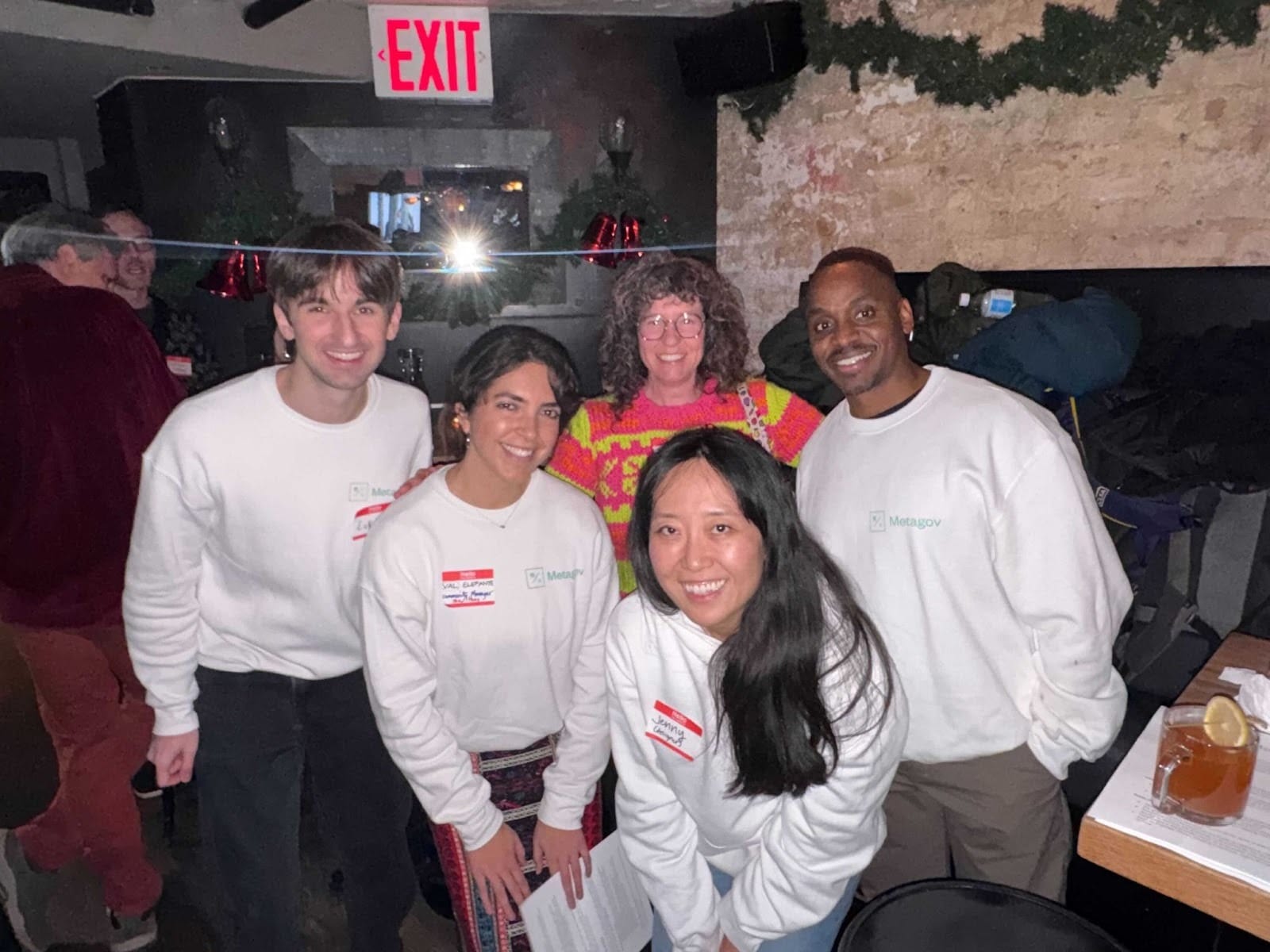
As we bid farewell to 2025, we’re grateful for the conversations, collaborations, and shared inquiries that continue to shape this work. BlockScience exists to help complex systems become more legible, governable, and resilient - and that work only moves forward through collective effort.
If something here sparked a question or connection, we’d love to hear from you at info@block.science.
Wishing you a reflective close to 2025 and an energizing start to what’s next in 2026! 🙏✨
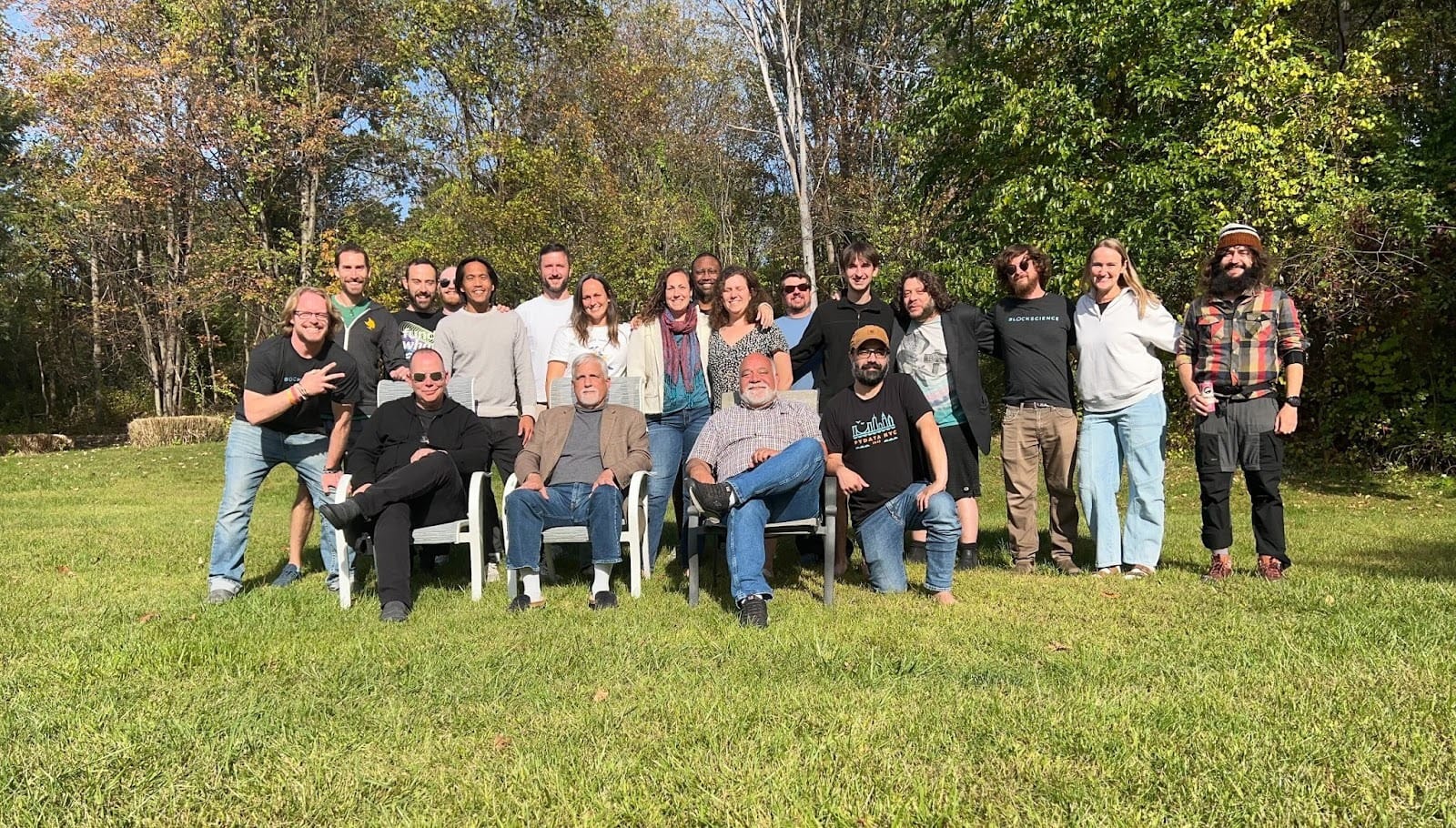
BlockScience® is a systems engineering firm that operationalizes emerging technologies for high reliability organizations. We partner with organizations in healthcare, energy, finance, and government to develop and integrate new capabilities while maintaining reliable operations. Operationalization doesn’t end with due diligence and procurement; it includes integration, calibration and validation. Our R&D practice goes beyond exploration: We operationalize emerging technologies within our own organization first, in order to differentiate between impressive demonstrations and practical solutions. This hands-on experience, combined with rigorous engineering discipline, enables us to cut through hype and provide honest assessments of organizational readiness and technological fitness-for-purpose. We support accountable executives with responsibility for making complex technologies work within their operational constraints, ensuring that people, processes, and tools function together reliably.
